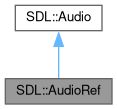
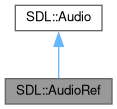
Public Member Functions | |
| constexpr | AudioRef (AudioRaw resource) noexcept |
| Constructs from raw Audio. More... | |
| constexpr | AudioRef (const Audio &resource) noexcept |
| Constructs from Audio. More... | |
| constexpr | AudioRef (Audio &&resource) noexcept |
| Constructs from Audio. More... | |
| constexpr | AudioRef (const AudioRef &other) noexcept |
| Copy constructor. | |
| constexpr | AudioRef (AudioRef &&other) noexcept |
| Move constructor. | |
| ~AudioRef () | |
| Destructor. | |
| AudioRef & | operator= (const AudioRef &other) noexcept |
| Assignment operator. | |
| constexpr | operator AudioRaw () const noexcept |
| Converts to AudioRaw. | |
| constexpr | Audio (std::nullptr_t=nullptr) noexcept |
| Default ctor. | |
| constexpr | Audio (AudioRaw resource) noexcept |
| Constructs from raw Audio. More... | |
| constexpr | Audio (const Audio &other) noexcept=delete |
| Copy constructor. | |
| constexpr | Audio (Audio &&other) noexcept |
| Move constructor. | |
| constexpr | Audio (const AudioRef &other)=delete |
| constexpr | Audio (AudioRef &&other)=delete |
| Audio (MixerRef mixer, IOStreamRef io, bool predecode, bool closeio=false) | |
| Load audio for playback from an IOStream. More... | |
| Audio (MixerRef mixer, StringParam path, bool predecode) | |
| Load audio for playback from a file. More... | |
| Audio (PropertiesRef props) | |
| Load audio for playback through a collection of properties. More... | |
| Audio (MixerRef mixer, IOStreamRef io, const AudioSpec &spec, bool closeio=false) | |
| Load raw PCM data from an IOStream. More... | |
| Audio (MixerRef mixer, SourceBytes data, const AudioSpec &spec) | |
| Load raw PCM data from a memory buffer. More... | |
 Public Member Functions inherited from SDL::Audio Public Member Functions inherited from SDL::Audio | |
| constexpr | Audio (std::nullptr_t=nullptr) noexcept |
| Default ctor. | |
| constexpr | Audio (AudioRaw resource) noexcept |
| Constructs from raw Audio. More... | |
| constexpr | Audio (const Audio &other) noexcept=delete |
| Copy constructor. | |
| constexpr | Audio (Audio &&other) noexcept |
| Move constructor. | |
| constexpr | Audio (const AudioRef &other)=delete |
| constexpr | Audio (AudioRef &&other)=delete |
| Audio (MixerRef mixer, IOStreamRef io, bool predecode, bool closeio=false) | |
| Load audio for playback from an IOStream. More... | |
| Audio (MixerRef mixer, StringParam path, bool predecode) | |
| Load audio for playback from a file. More... | |
| Audio (PropertiesRef props) | |
| Load audio for playback through a collection of properties. More... | |
| Audio (MixerRef mixer, IOStreamRef io, const AudioSpec &spec, bool closeio=false) | |
| Load raw PCM data from an IOStream. More... | |
| Audio (MixerRef mixer, SourceBytes data, const AudioSpec &spec) | |
| Load raw PCM data from a memory buffer. More... | |
| ~Audio () | |
| Destructor. | |
| constexpr Audio & | operator= (Audio &&other) noexcept |
| Assignment operator. | |
| Audio & | operator= (const Audio &other)=delete |
| Assignment operator. | |
| constexpr AudioRaw | get () const noexcept |
| Retrieves underlying AudioRaw. | |
| constexpr AudioRaw | release () noexcept |
| Retrieves underlying AudioRaw and clear this. | |
| constexpr auto | operator<=> (const Audio &other) const noexcept=default |
| Comparison. | |
| constexpr | operator bool () const noexcept |
| Converts to bool. | |
| void | Destroy () |
| Destroy the specified audio. More... | |
| PropertiesRef | GetProperties () |
| Get the properties associated with a Audio. More... | |
| Sint64 | GetDuration () |
| Get the length of a Audio's playback in sample frames. More... | |
| void | GetFormat (AudioSpec *spec) |
| Query the initial audio format of a Audio. More... | |
| Sint64 | MSToFrames (Milliseconds ms) |
| Convert milliseconds to sample frames for a Audio's format. More... | |
| Milliseconds | FramesToMS (Sint64 frames) |
| Convert sample frames for a Audio's format to milliseconds. More... | |
Detailed Description
This does not take ownership!
Constructor & Destructor Documentation
◆ AudioRef() [1/3]
|
inlineconstexprnoexcept |
- Parameters
-
resource a AudioRaw.
This does not takes ownership!
◆ AudioRef() [2/3]
|
inlineconstexprnoexcept |
- Parameters
-
resource a Audio.
This does not takes ownership!
◆ AudioRef() [3/3]
|
inlineconstexprnoexcept |
- Parameters
-
resource a Audio.
This will release the ownership from resource!
Member Function Documentation
◆ Audio() [1/6]
|
inlineexplicitconstexprnoexcept |
- Parameters
-
resource a AudioRaw to be wrapped.
This assumes the ownership, call release() if you need to take back.
◆ Audio() [2/6]
|
inline |
In normal usage, apps should load audio once, maybe at startup, then play it multiple times.
When loading audio, it will be cached fully in RAM in its original data format. Each time it plays, the data will be decoded. For example, an MP3 will be stored in memory in MP3 format and be decompressed on the fly during playback. This is a tradeoff between i/o overhead and memory usage.
If predecode is true, the data will be decompressed during load and stored as raw PCM data. This might dramatically increase loading time and memory usage, but there will be no need to decompress data during playback.
(One could also use Track.SetIOStream() to bypass loading the data into RAM upfront at all, but this offers still different tradeoffs. The correct approach depends on the app's needs and employing different approaches in different situations can make sense.)
Audio objects can be shared between mixers. This function takes a Mixer, to imply this is the most likely place it will be used and loading should try to match its audio format, but the resulting audio can be used elsewhere. If mixer is nullptr, SDL_mixer will set reasonable defaults.
Once a Audio is created, it can be assigned to a Track with Track.SetAudio(), or played without any management with Mixer.PlayAudio().
When done with a Audio, it can be freed with Audio.Destroy().
This function loads data from an IOStream. There is also a version that loads from a path on the filesystem (Mixer.LoadAudio()), and one that accepts properties for ultimate control (LoadAudioWithProperties()).
The IOStream provided must be able to seek, or loading will fail. If the stream can't seek (data is coming from an HTTP connection, etc), consider caching the data to memory or disk first and creating a new stream to read from there.
- Parameters
-
mixer a mixer this audio is intended to be used with. May be nullptr. io the IOStream to load data from. predecode if true, data will be fully uncompressed before returning. closeio true if SDL_mixer should close iobefore returning (success or failure).
- Postcondition
- an audio object that can be used to make sound on a mixer, or nullptr on failure; call GetError() for more information.
- Thread safety:
- It is safe to call this function from any thread.
- Since
- This function is available since SDL_mixer 3.0.0.
◆ Audio() [3/6]
|
inline |
There are other options for streaming raw PCM: an AudioStream can be connected to a track, as can an IOStream, and will read from those sources on-demand when it is time to mix the audio. This function is useful for loading static audio data that is meant to be played multiple times.
This function will load the raw data in its entirety and cache it in RAM.
Audio objects can be shared between multiple mixers. The mixer parameter just suggests the most likely mixer to use this audio, in case some optimization might be applied, but this is not required, and a nullptr mixer may be specified.
- Parameters
-
mixer a mixer this audio is intended to be used with. May be nullptr. io the IOStream to load data from. spec what format the raw data is in. closeio true if SDL_mixer should close iobefore returning (success or failure).
- Postcondition
- an audio object that can be used to make sound on a mixer on success.
- Exceptions
-
Error on failure.
- Thread safety:
- It is safe to call this function from any thread.
- Since
- This function is available since SDL_mixer 3.0.0.
◆ Audio() [4/6]
|
inline |
There are other options for streaming raw PCM: an AudioStream can be connected to a track, as can an IOStream, and will read from those sources on-demand when it is time to mix the audio. This function is useful for loading static audio data that is meant to be played multiple times.
This function will load the raw data in its entirety and cache it in RAM, allocating a copy. If the original data will outlive the created Audio, you can use Mixer.LoadRawAudioNoCopy() to avoid extra allocations and copies.
Audio objects can be shared between multiple mixers. The mixer parameter just suggests the most likely mixer to use this audio, in case some optimization might be applied, but this is not required, and a nullptr mixer may be specified.
- Parameters
-
mixer a mixer this audio is intended to be used with. May be nullptr. data the raw PCM data to load. spec what format the raw data is in.
- Postcondition
- an audio object that can be used to make sound on a mixer on success.
- Exceptions
-
Error on failure.
- Thread safety:
- It is safe to call this function from any thread.
- Since
- This function is available since SDL_mixer 3.0.0.
◆ Audio() [5/6]
|
inline |
This is equivalent to calling:
This function loads data from a path on the filesystem. There is also a version that loads from an IOStream (Mixer.LoadAudio_IO()), and one that accepts properties for ultimate control (LoadAudioWithProperties()).
- Parameters
-
mixer a mixer this audio is intended to be used with. May be nullptr. path the path on the filesystem to load data from. predecode if true, data will be fully uncompressed before returning.
- Postcondition
- an audio object that can be used to make sound on a mixer, or nullptr on failure; call GetError() for more information.
- Thread safety:
- It is safe to call this function from any thread.
- Since
- This function is available since SDL_mixer 3.0.0.
◆ Audio() [6/6]
|
inline |
Please see Mixer.LoadAudio_IO() for a description of what the various LoadAudio functions do. This function uses properties to dictate how it operates, and exposes functionality the other functions don't provide.
Properties are discussed in SDL's documentation .
These are the supported properties:
prop::Audio.LOAD_IOSTREAM_POINTER: a pointer to an IOStream to be used to load audio data. Required. This stream must be able to seek!prop::Audio.LOAD_CLOSEIO_BOOLEAN: true if SDL_mixer should close the IOStream before returning (success or failure).prop::Audio.LOAD_PREDECODE_BOOLEAN: true if SDL_mixer should fully decode and decompress the data before returning. Otherwise it will be stored in its original state and decompressed on demand.prop::Audio.LOAD_PREFERRED_MIXER_POINTER: a pointer to a Mixer, in case steps can be made to match its format when decoding. Optional.prop::Audio.LOAD_SKIP_METADATA_TAGS_BOOLEAN: true to skip parsing metadata tags, like ID3 and APE tags. This can be used to speed up loading if the data definitely doesn't have these tags. Some decoders will fail if these tags are present when this property is true.prop::Audio.DECODER_STRING: the name of the decoder to use for this data. Optional. If not specified, SDL_mixer will examine the data and choose the best decoder. These names are the same returned from GetAudioDecoder().
Specific decoders might accept additional custom properties, such as where to find soundfonts for MIDI playback, etc.
- Parameters
-
props a set of properties on how to load audio.
- Postcondition
- an audio object that can be used to make sound on a mixer on success.
- Exceptions
-
Error on failure.
- Thread safety:
- It is safe to call this function from any thread.
- Since
- This function is available since SDL_mixer 3.0.0.
The documentation for this struct was generated from the following file:
- SDL3pp/SDL3pp_mixer.h