Safe reference for Texture.
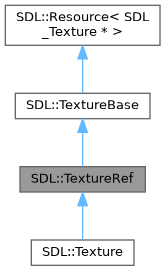
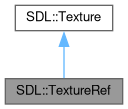
Public Member Functions | |
| TextureRef (TextureRaw resource) noexcept | |
| Constructs from TextureRaw. More... | |
| TextureRef (Texture resource) noexcept | |
| Constructs from Texture. | |
| constexpr | Texture (std::nullptr_t=nullptr) noexcept |
| Default ctor. | |
| constexpr | Texture (const TextureRaw resource) noexcept |
| Constructs from TextureParam. More... | |
| constexpr | Texture (const Texture &other) |
| Copy constructor. | |
| constexpr | Texture (Texture &&other) noexcept |
| Move constructor. | |
| Texture (RendererParam renderer, PixelFormat format, TextureAccess access, const PointRaw &size) | |
| Create a texture for a rendering context. More... | |
| Texture (RendererParam renderer, SurfaceParam surface) | |
| Create a texture from an existing surface. More... | |
| Texture (RendererParam renderer, PropertiesParam props) | |
| Create a texture for a rendering context with the specified properties. More... | |
| Texture (RendererParam renderer, StringParam file) | |
| Load an image from a filesystem path into a texture. More... | |
| Texture (RendererParam renderer, IOStreamParam src, bool closeio=false) | |
| Load an image from an SDL data source into a texture. More... | |
 Public Member Functions inherited from SDL::Texture Public Member Functions inherited from SDL::Texture | |
| constexpr | Texture (std::nullptr_t=nullptr) noexcept |
| Default ctor. | |
| constexpr | Texture (const TextureRaw resource) noexcept |
| Constructs from TextureParam. More... | |
| constexpr | Texture (const Texture &other) |
| Copy constructor. | |
| constexpr | Texture (Texture &&other) noexcept |
| Move constructor. | |
| Texture (RendererParam renderer, PixelFormat format, TextureAccess access, const PointRaw &size) | |
| Create a texture for a rendering context. More... | |
| Texture (RendererParam renderer, SurfaceParam surface) | |
| Create a texture from an existing surface. More... | |
| Texture (RendererParam renderer, PropertiesParam props) | |
| Create a texture for a rendering context with the specified properties. More... | |
| Texture (RendererParam renderer, StringParam file) | |
| Load an image from a filesystem path into a texture. More... | |
| Texture (RendererParam renderer, IOStreamParam src, bool closeio=false) | |
| Load an image from an SDL data source into a texture. More... | |
| constexpr const TextureRaw | operator-> () const noexcept |
| member access to underlying TextureRaw. | |
| constexpr TextureRaw | operator-> () noexcept |
| member access to underlying TextureRaw. | |
| ~Texture () | |
| Destructor. | |
| constexpr Texture & | operator= (Texture &&other) noexcept |
| Assignment operator. | |
| constexpr Texture & | operator= (const Texture &other) noexcept=default |
| Assignment operator. | |
| constexpr TextureRaw | get () const noexcept |
| Retrieves underlying TextureRaw. | |
| constexpr TextureRaw | release () noexcept |
| Retrieves underlying TextureRaw and clear this. | |
| constexpr auto | operator<=> (const Texture &other) const noexcept=default |
| Comparison. | |
| constexpr | operator bool () const noexcept |
| Converts to bool. | |
| constexpr | operator TextureParam () const noexcept |
| Converts to TextureParam. | |
| void | Destroy () |
| Destroy the specified texture. More... | |
| PropertiesRef | GetProperties () const |
| Get the properties associated with a texture. More... | |
| RendererRef | GetRenderer () const |
| Get the renderer that created an Texture. More... | |
| void | GetSize (float *w, float *h) const |
| Get the size of a texture, as floating point values. More... | |
| Point | GetSize () const |
| Get the size of a texture. | |
| FPoint | GetSizeFloat () const |
| Get the size of a texture, as floating point values. | |
| int | GetWidth () const |
| Get the width in pixels. | |
| int | GetHeight () const |
| Get the height in pixels. | |
| PixelFormat | GetFormat () const |
| Get the pixel format. | |
| void | SetPalette (PaletteParam palette) |
| Set the palette used by a texture. More... | |
| Palette | GetPalette () |
| Get the palette used by a texture. More... | |
| void | SetColorMod (Uint8 r, Uint8 g, Uint8 b) |
| Set an additional color value multiplied into render copy operations. More... | |
| void | SetColorModFloat (float r, float g, float b) |
| Set an additional color value multiplied into render copy operations. More... | |
| void | GetColorMod (Uint8 *r, Uint8 *g, Uint8 *b) const |
| Get the additional color value multiplied into render copy operations. More... | |
| void | GetColorModFloat (float *r, float *g, float *b) const |
| Get the additional color value multiplied into render copy operations. More... | |
| void | SetAlphaMod (Uint8 alpha) |
| Set an additional alpha value multiplied into render copy operations. More... | |
| void | SetAlphaModFloat (float alpha) |
| Set an additional alpha value multiplied into render copy operations. More... | |
| Uint8 | GetAlphaMod () const |
| Get the additional alpha value multiplied into render copy operations. More... | |
| float | GetAlphaModFloat () const |
| Get the additional alpha value multiplied into render copy operations. More... | |
| void | SetMod (Color c) |
| Set an additional color and alpha values multiplied into render copy operations. More... | |
| void | SetModFloat (FColor c) |
| Set an additional color and alpha values multiplied into render copy operations. More... | |
| Color | GetMod () const |
| Get the additional color value multiplied into render copy operations. More... | |
| FColor | GetModFloat () const |
| Get the additional color value multiplied into render copy operations. More... | |
| void | SetBlendMode (BlendMode blendMode) |
| Set the blend mode for a texture, used by Renderer.RenderTexture(). More... | |
| BlendMode | GetBlendMode () const |
| Get the blend mode used for texture copy operations. More... | |
| void | SetScaleMode (ScaleMode scaleMode) |
| Set the scale mode used for texture scale operations. More... | |
| ScaleMode | GetScaleMode () const |
| Get the scale mode used for texture scale operations. More... | |
| void | Update (OptionalRef< const RectRaw > rect, const void *pixels, int pitch) |
| Update the given texture rectangle with new pixel data. More... | |
| void | Update (SurfaceConstParam surface, OptionalRef< const RectRaw > rect=std::nullopt) |
| Update the given texture rectangle with new pixel data. More... | |
| void | UpdateYUV (OptionalRef< const RectRaw > rect, const Uint8 *Yplane, int Ypitch, const Uint8 *Uplane, int Upitch, const Uint8 *Vplane, int Vpitch) |
| Update a rectangle within a planar YV12 or IYUV texture with new pixel data. More... | |
| void | UpdateNV (OptionalRef< const RectRaw > rect, const Uint8 *Yplane, int Ypitch, const Uint8 *UVplane, int UVpitch) |
| Update a rectangle within a planar NV12 or NV21 texture with new pixels. More... | |
| TextureLock | Lock (OptionalRef< const RectRaw > rect, void **pixels, int *pitch) |
| Lock a portion of the texture for write-only pixel access. More... | |
| TextureSurfaceLock | LockToSurface (OptionalRef< const RectRaw > rect=std::nullopt) |
| Lock a portion of the texture for write-only pixel access, and expose it as a SDL surface. More... | |
| void | Unlock (TextureLock &&lock) |
| Unlock a texture, uploading the changes to video memory, if needed. More... | |
| void | Unlock (TextureSurfaceLock &&lock) |
| Unlock a texture, uploading the changes to video memory, if needed. More... | |
Additional Inherited Members | |
| Static Public Member Functions inherited from SDL::Texture | |
| static constexpr Texture | Borrow (TextureParam resource) |
| Safely borrows the from TextureParam. More... | |
Constructor & Destructor Documentation
◆ TextureRef()
|
inlinenoexcept |
- Parameters
-
resource a TextureRaw.
This borrows the ownership, increments the refcount!
Member Function Documentation
◆ Texture() [1/6]
|
inlineexplicitconstexprnoexcept |
- Parameters
-
resource a TextureRaw to be wrapped.
This assumes the ownership, call release() if you need to take back.
◆ Texture() [2/6]
|
inline |
An Texture represents an image in GPU memory, usable by SDL's 2D Render API. This can be significantly more efficient than using a CPU-bound Surface if you don't need to manipulate the image directly after loading it.
If the loaded image has transparency or a colorkey, a texture with an alpha channel will be created. Otherwise, SDL_image will attempt to create an Texture in the most format that most reasonably represents the image data (but in many cases, this will just end up being 32-bit RGB or 32-bit RGBA).
If closeio is true, src will be closed before returning, whether this function succeeds or not. SDL_image reads everything it needs from src during this call in any case.
There is a separate function to read files from disk without having to deal with IOStream: Texture.Texture(renderer, "filename.jpg") will call this function and manage those details for you, determining the file type from the filename's extension.
There is also LoadTextureTyped(), which is equivalent to this function except a file extension (like "BMP", "JPG", etc) can be specified, in case SDL_image cannot autodetect the file format.
If you would rather decode an image to an Surface (a buffer of pixels in CPU memory), call Surface.Surface() instead.
- Parameters
-
renderer the Renderer to use to create the texture. src an IOStream that data will be read from. closeio true to close/free the IOStream before returning, false to leave it open.
- Postcondition
- a new texture, or nullptr on error.
- Since
- This function is available since SDL_image 3.0.0.
- See also
- Texture.Texture
- LoadTextureTyped
◆ Texture() [3/6]
|
inline |
The contents of a texture when first created are not defined.
- Parameters
-
renderer the rendering context. format one of the enumerated values in PixelFormat. access one of the enumerated values in TextureAccess. size the width and height of the texture in pixels.
- Exceptions
-
Error on failure.
- Thread safety:
- This function should only be called on the main thread.
- Since
- This function is available since SDL 3.2.0.
◆ Texture() [4/6]
|
inline |
These are the supported properties:
prop::Texture.CREATE_COLORSPACE_NUMBER: an Colorspace value describing the texture colorspace, defaults to COLORSPACE_SRGB_LINEAR for floating point textures, COLORSPACE_HDR10 for 10-bit textures, COLORSPACE_SRGB for other RGB textures and COLORSPACE_JPEG for YUV textures.prop::Texture.CREATE_FORMAT_NUMBER: one of the enumerated values in PixelFormat, defaults to the best RGBA format for the rendererprop::Texture.CREATE_ACCESS_NUMBER: one of the enumerated values in TextureAccess, defaults to TEXTUREACCESS_STATICprop::Texture.CREATE_WIDTH_NUMBER: the width of the texture in pixels, requiredprop::Texture.CREATE_HEIGHT_NUMBER: the height of the texture in pixels, requiredprop::Texture.CREATE_PALETTE_POINTER: an Palette to use with palettized texture formats. This can be set later with Texture.SetPalette()prop::Texture.CREATE_SDR_WHITE_POINT_FLOAT: for HDR10 and floating point textures, this defines the value of 100% diffuse white, with higher values being displayed in the High Dynamic Range headroom. This defaults to 100 for HDR10 textures and 1.0 for floating point textures.prop::Texture.CREATE_HDR_HEADROOM_FLOAT: for HDR10 and floating point textures, this defines the maximum dynamic range used by the content, in terms of the SDR white point. This would be equivalent to maxCLL / prop::Texture.CREATE_SDR_WHITE_POINT_FLOAT for HDR10 content. If this is defined, any values outside the range supported by the display will be scaled into the available HDR headroom, otherwise they are clipped.
With the direct3d11 renderer:
prop::Texture.CREATE_D3D11_TEXTURE_POINTER: the ID3D11Texture2D associated with the texture, if you want to wrap an existing texture.prop::Texture.CREATE_D3D11_TEXTURE_U_POINTER: the ID3D11Texture2D associated with the U plane of a YUV texture, if you want to wrap an existing texture.prop::Texture.CREATE_D3D11_TEXTURE_V_POINTER: the ID3D11Texture2D associated with the V plane of a YUV texture, if you want to wrap an existing texture.
With the direct3d12 renderer:
prop::Texture.CREATE_D3D12_TEXTURE_POINTER: the ID3D12Resource associated with the texture, if you want to wrap an existing texture.prop::Texture.CREATE_D3D12_TEXTURE_U_POINTER: the ID3D12Resource associated with the U plane of a YUV texture, if you want to wrap an existing texture.prop::Texture.CREATE_D3D12_TEXTURE_V_POINTER: the ID3D12Resource associated with the V plane of a YUV texture, if you want to wrap an existing texture.
With the metal renderer:
prop::Texture.CREATE_METAL_PIXELBUFFER_POINTER: the CVPixelBufferRef associated with the texture, if you want to create a texture from an existing pixel buffer.
With the opengl renderer:
prop::Texture.CREATE_OPENGL_TEXTURE_NUMBER: the GLuint texture associated with the texture, if you want to wrap an existing texture.prop::Texture.CREATE_OPENGL_TEXTURE_UV_NUMBER: the GLuint texture associated with the UV plane of an NV12 texture, if you want to wrap an existing texture.prop::Texture.CREATE_OPENGL_TEXTURE_U_NUMBER: the GLuint texture associated with the U plane of a YUV texture, if you want to wrap an existing texture.prop::Texture.CREATE_OPENGL_TEXTURE_V_NUMBER: the GLuint texture associated with the V plane of a YUV texture, if you want to wrap an existing texture.
With the opengles2 renderer:
prop::Texture.CREATE_OPENGLES2_TEXTURE_NUMBER: the GLuint texture associated with the texture, if you want to wrap an existing texture.prop::Texture.CREATE_OPENGLES2_TEXTURE_NUMBER: the GLuint texture associated with the texture, if you want to wrap an existing texture.prop::Texture.CREATE_OPENGLES2_TEXTURE_UV_NUMBER: the GLuint texture associated with the UV plane of an NV12 texture, if you want to wrap an existing texture.prop::Texture.CREATE_OPENGLES2_TEXTURE_U_NUMBER: the GLuint texture associated with the U plane of a YUV texture, if you want to wrap an existing texture.prop::Texture.CREATE_OPENGLES2_TEXTURE_V_NUMBER: the GLuint texture associated with the V plane of a YUV texture, if you want to wrap an existing texture.
With the vulkan renderer:
prop::Texture.CREATE_VULKAN_TEXTURE_NUMBER: the VkImage associated with the texture, if you want to wrap an existing texture.prop::Texture.CREATE_VULKAN_LAYOUT_NUMBER: the VkImageLayout for the VkImage, defaults to VK_IMAGE_LAYOUT_SHADER_READ_ONLY_OPTIMAL.
With the GPU renderer:
prop::Texture.CREATE_GPU_TEXTURE_POINTER: the GPUTexture associated with the texture, if you want to wrap an existing texture.SDL_PROP_TEXTURE_CREATE_GPU_TEXTURE_UV_NUMBER: the GPUTexture associated with the UV plane of an NV12 texture, if you want to wrap an existing texture.SDL_PROP_TEXTURE_CREATE_GPU_TEXTURE_U_NUMBER: the GPUTexture associated with the U plane of a YUV texture, if you want to wrap an existing texture.SDL_PROP_TEXTURE_CREATE_GPU_TEXTURE_V_NUMBER: the GPUTexture associated with the V plane of a YUV texture, if you want to wrap an existing texture.
- Parameters
-
renderer the rendering context. props the properties to use.
- Exceptions
-
Error on failure.
- Thread safety:
- This function should only be called on the main thread.
- Since
- This function is available since SDL 3.2.0.
◆ Texture() [5/6]
|
inline |
An Texture represents an image in GPU memory, usable by SDL's 2D Render API. This can be significantly more efficient than using a CPU-bound Surface if you don't need to manipulate the image directly after loading it.
If the loaded image has transparency or a colorkey, a texture with an alpha channel will be created. Otherwise, SDL_image will attempt to create an Texture in the most format that most reasonably represents the image data (but in many cases, this will just end up being 32-bit RGB or 32-bit RGBA).
There is a separate function to read files from an IOStream, if you need an i/o abstraction to provide data from anywhere instead of a simple filesystem read; that function is Texture.Texture().
If you would rather decode an image to an Surface (a buffer of pixels in CPU memory), call Surface.Surface() instead.
- Parameters
-
renderer the Renderer to use to create the texture. file a path on the filesystem to load an image from.
- Postcondition
- a new texture, or nullptr on error.
- Since
- This function is available since SDL_image 3.0.0.
- See also
- LoadTextureTyped
- Texture.Texture
◆ Texture() [6/6]
|
inline |
The surface is not modified or freed by this function.
The TextureAccess hint for the created texture is TEXTUREACCESS_STATIC.
The pixel format of the created texture may be different from the pixel format of the surface, and can be queried using the prop::Texture.FORMAT_NUMBER property.
- Parameters
-
renderer the rendering context. surface the Surface structure containing pixel data used to fill the texture.
- Exceptions
-
Error on failure.
- Thread safety:
- This function should only be called on the main thread.
- Since
- This function is available since SDL 3.2.0.
- See also
- Texture.Texture
- Texture.Destroy
The documentation for this struct was generated from the following file:
- SDL3pp/SDL3pp_render.h